How to Prepare a Tortoise Table Properly
A tortoise table should be ready, warmed up and checked before your tortoise comes home. It is not simply a box with a lamp attached. The temperature gradient, UVB, substrate depth and hiding areas all affect whether a young tortoise can feed, digest and settle properly. Knowing how to prepare tortoise table conditions correctly gives your new pet the secure start it needs.
For many UK keepers, a tortoise table is most useful for a hatchling or juvenile, and as an indoor base during cooler weather. It must be set up for the species and the individual tortoise, rather than copied from a photograph online. Horsfield, Hermann’s and Marginated tortoises have overlapping needs, but their eventual size, activity levels and tolerance of damp conditions differ.
Choose the right tortoise table first
An open-topped wooden tortoise table is popular because it gives good access and allows fresh air to circulate. It must, however, be large enough to create distinct warm and cooler areas. A small table may look suitable for a tiny tortoise on day one, but it quickly becomes restrictive and makes correct temperatures difficult to achieve.
For a young tortoise, choose the largest table you can sensibly accommodate. As a starting point, aim for at least 4 ft by 2 ft for a juvenile, with a plan to increase the space as it grows. Adult garden tortoises require much more room and, where conditions allow, a secure outdoor enclosure is normally the better long-term arrangement. A tortoise table is not a permanent answer for every adult tortoise.
The sides should be high enough to prevent climbing and lined or sealed so moisture from the substrate cannot damage the wood. Avoid glass-fronted tanks as a first choice. Tortoises often pace against clear barriers, and a vivarium can become overly warm or poorly ventilated if it is not carefully managed.
Place the table away from draughts, radiators, busy doorways and direct sunlight through a window. Sunlight can overheat an enclosure surprisingly quickly, while window glass does not provide the UVB a tortoise needs.
How to prepare a tortoise table with heat and UVB
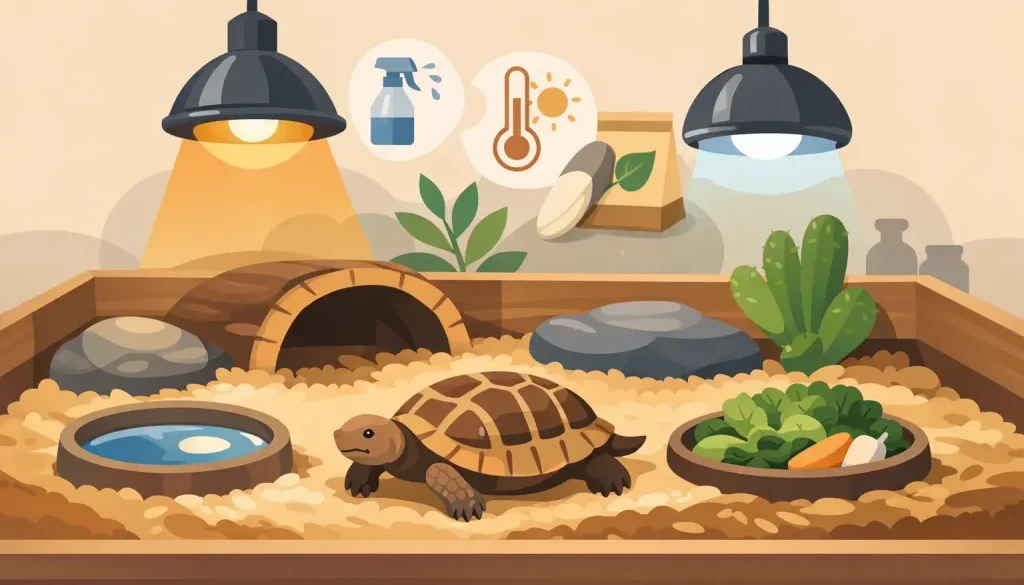
Your tortoise needs a warm basking area at one end and a noticeably cooler area at the other. This allows it to regulate its own body temperature by moving between zones. If the whole table is the same temperature, it cannot choose the conditions it needs.
Fit a suitable basking lamp securely above one end of the table, using a proper ceramic holder and guard where necessary. The exact bulb wattage and mounting height depend on the size of the table, room temperature and lamp type, so do not rely on a fixed distance alone. Check the temperature directly beneath the lamp using a reliable digital thermometer with a probe. For many Mediterranean tortoises, a basking area around 32-35°C is a sensible target, with cooler areas available away from the lamp.
A thermostat is strongly recommended for controlling heat equipment. It helps prevent overheating, particularly in centrally heated homes where room temperatures can change during the day. Cables, plugs and fittings should be kept out of reach, tidy and protected from moisture.
Alongside heat, provide a quality reptile UVB lamp. UVB helps a tortoise produce vitamin D3, which is needed to use calcium properly and support healthy shell and bone growth. The lamp should cover the area where the tortoise spends time, not merely shine into one corner. Replace UVB bulbs or tubes at the manufacturer’s advised interval, as they can still produce visible light after their useful UVB output has reduced.
Lighting usually follows a natural daytime routine. Around 10-12 hours of light is often suitable, adjusted sensibly with the season and your tortoise’s management plan. Timers make this consistent and avoid lamps being left on late into the evening.
Use a safe, natural substrate
Substrate is more than decoration. It gives the tortoise footing, allows it to dig and helps maintain an appropriate level of humidity close to the ground. For young Hermann’s, Marginated and Western Dwarf Hermann’s tortoises, a natural soil-based substrate is generally a good option. It should be clean, free from fertiliser, pesticides and added perlite.
Use enough depth for the tortoise to settle partly into the substrate and burrow if it wishes. A shallow scattering is not enough. Keep it mostly dry but not bone dry throughout, especially for hatchlings and young juveniles, which can dehydrate easily. Lightly dampening one area, rather than soaking the whole table, creates a useful choice of microclimates.
Horsfield tortoises generally prefer drier conditions than some other Mediterranean species. Their substrate should still be natural and diggable, but it should not be kept wet. This is where species-specific advice matters. A single care sheet cannot account for every room, season or tortoise.
Avoid calcium sand, loose wood shavings, scented bedding, cat litter and gravel. These can cause irritation, impaction or injury if swallowed, and they do not provide the natural surface a tortoise needs.
Add shelter, water and a feeding area
Every tortoise table needs at least one hide at the cooler end. A simple wooden shelter, cork bark hide or sturdy plant pot laid on its side can work well, provided it is stable and large enough for the tortoise to turn around. A second sheltered area can be helpful in a larger enclosure. Hiding is normal behaviour, not a sign that your tortoise is unhappy.
Provide a shallow, sturdy water dish sunk flush with the substrate so the tortoise can walk in and out easily. The water should be changed daily, and the dish cleaned regularly. Young tortoises also benefit from regular shallow warm baths, as advised for their species and age. A drinking dish is essential, but it does not replace bathing.
Feed on a flat slate, terracotta tile or similarly easy-to-clean surface. This keeps food out of the substrate and may help wear the beak naturally. Offer a varied diet of suitable leafy weeds and greens, rather than relying on watery lettuce or shop-bought fruit. Fruit is not a routine food for Mediterranean garden tortoises.
A separate small dish for calcium supplement can be useful where appropriate. Do not add supplements indiscriminately or assume they can correct poor lighting or an unsuitable diet. Good husbandry works as a whole.
Check the setup before your tortoise arrives
Run the tortoise table for at least a day before introducing your tortoise. Take readings under the basking lamp, in the middle and at the cool end, then check again later in the day. A table that appears correct first thing in the morning may become too hot by afternoon.
Watch for practical risks as well. Can a tortoise get behind a hide and become trapped? Is the water bowl shallow enough? Is the lamp fixed securely? Can a curious child or another household pet reach the table? These details matter just as much as buying the right equipment.
Clean food and water dishes daily, remove spoiled food promptly and spot-clean soiled substrate. A full clean is needed when the substrate is no longer fresh, but constantly stripping out every familiar scent can be unsettling. Keep the table clean, dry where it should be dry, and monitored rather than repeatedly rearranged.
Know when an outdoor enclosure is the better option
A properly designed outdoor pen offers natural sunlight, space and opportunities for browsing, which are difficult to replicate indoors. In suitable UK weather, this is valuable for healthy tortoises. The enclosure must be secure from escape and predators, include shelter and shade, and be used only when temperatures are appropriate for the species.
Do not put a young tortoise outside unattended simply because the sun is out. Chilly winds, sudden rain, overheating and predation are real risks. Very small tortoises are particularly vulnerable. Many keepers use their tortoise table as the dependable indoor base, then introduce carefully supervised outdoor time as conditions permit.
If you are preparing for your first tortoise, set the table up before arranging collection or delivery and ask questions early. At Tortoises 4 You, free, friendly husbandry advice is available because the right enclosure is part of responsible ownership, not an afterthought. A calm tortoise that can bask, graze, drink, hide and explore at its own pace is the best sign that you have prepared its home well.