Do Tortoises Need Heat Lamps? UK Care Advice
A tortoise sitting under a lamp is not simply getting comfortable. It is warming its body so it can move properly, digest food and use the nutrients in its diet. For most pet keepers in Britain, the answer to do tortoises need heat lamps is yes when the tortoise is housed indoors – but the type of heat, the temperature and the length of time the lamp is used all matter.
Horsfield, Hermann’s, Marginated and Western Dwarf Hermann’s tortoises are often described as hardy species. That does not mean they can be kept in a cold room without the right equipment. Their natural habitats may have cool nights and seasonal changes, but they also provide strong daylight and warm areas where the animal can raise its body temperature. An indoor enclosure must offer the same choice safely.
Do tortoises need heat lamps indoors?
A tortoise is ectothermic, which means it relies on its surroundings to regulate body temperature. Unlike us, it cannot create enough internal heat to stay active in a centrally heated house. Even a room that feels pleasantly warm to people is usually too cool for a tortoise to reach its preferred daytime working temperature.
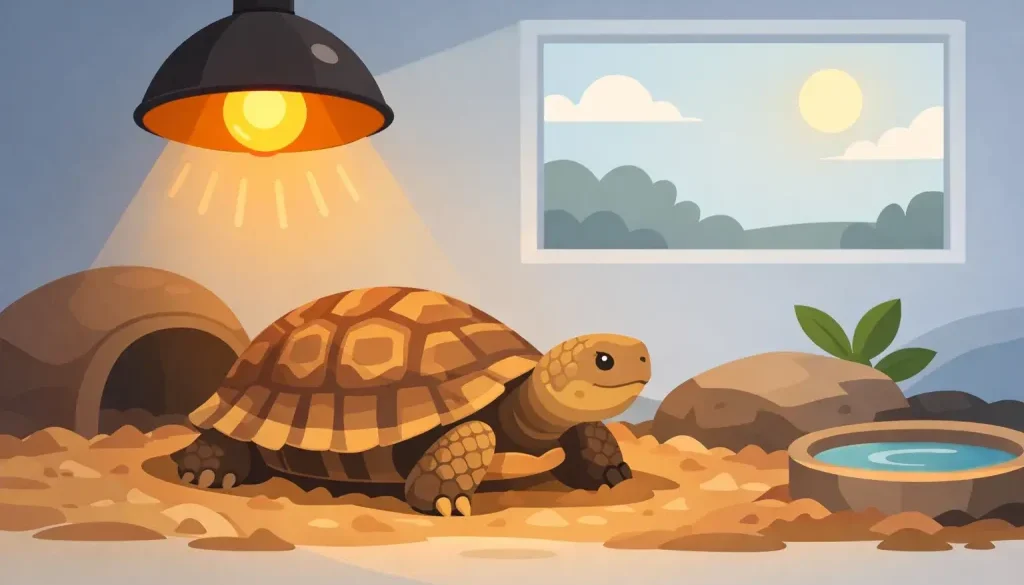
A heat lamp creates a warm basking area at one end of the enclosure. The other end should remain cooler. This temperature gradient is essential: a tortoise should be able to warm up when it needs to, then walk away to cool down. Heating the entire enclosure to one uniform temperature takes away that control.
For a healthy juvenile or adult Mediterranean tortoise kept indoors during the day, aim for a basking area of roughly 30-35°C. The cooler end will commonly sit around 20-24°C, depending on the room and enclosure. These are useful starting points, not a reason to guess. Check temperatures with a reliable digital thermometer, ideally using a probe placed at tortoise height beneath the lamp.
A lamp that feels warm when you hold your hand beneath it may still be inadequate at ground level. Equally, a powerful lamp placed too close can cause burns or overheat a small enclosure. Measure it properly before allowing your tortoise access.
Heat lamps and UVB are different jobs
A frequent mistake for first-time keepers is assuming that one lamp does everything. Heat and UVB serve separate purposes, although some specialist bulbs provide both.
Heat supports normal activity, appetite and digestion. UVB lighting helps a tortoise produce vitamin D3, which is needed to use calcium correctly and maintain healthy bones and shell growth. Without adequate UVB and a suitable diet, a tortoise can develop serious long-term health problems, including metabolic bone disease.
A standard household bulb, ceramic heater or heat mat may provide warmth, but it does not provide UVB. A UVB strip or suitable mercury vapour lamp can supply UVB, but the equipment must be correctly positioned and replaced in line with the manufacturer’s recommended schedule. A bulb may still visibly shine after its useful UVB output has reduced.
For many indoor set-ups, a separate overhead basking bulb and quality UVB tube are straightforward to manage. The tortoise receives heat from above, as it would from the sun, and can bask beneath appropriate UVB. The exact equipment depends on enclosure size, species, age and the natural daylight available. This is one of the areas where getting advice before buying saves money and avoids unsuitable set-ups.
Why heat mats are not usually the answer
Heat mats are commonly sold for reptiles, but they are generally not the best main heat source for tortoises. Tortoises naturally warm themselves from above. A mat placed underneath can create an unnatural hot spot beneath the animal, while leaving the air and upper shell too cool.
There is also a practical safety issue. A tortoise may sit over a warm mat for too long, particularly if it is unwell or unable to move freely. If supplementary low-level warmth is ever considered, it should be discussed with an experienced tortoise keeper or reptile veterinary surgeon and controlled by a thermostat. It should never be an unmonitored substitute for proper overhead basking heat.
Do tortoises need heat lamps at night?
In most ordinary indoor situations, no. Healthy Mediterranean tortoises do not need a bright heat lamp left on overnight. They benefit from a clear day-and-night routine, and light during the night can disturb natural resting behaviour.
A modest night-time drop is normal. For a settled, healthy tortoise, temperatures around 15-18°C overnight are generally acceptable. Many UK homes remain within or above this range, even in cooler months. A warm, secure sleeping area and dry substrate are as valuable as chasing a high overnight temperature.
There are exceptions. Very young tortoises, animals recovering from illness, or tortoises kept in an unusually cold property may need extra support. In these cases, use a thermostatically controlled ceramic heat emitter or other non-light-emitting heat source if advised. The goal is not to keep the tortoise hot all night, but to prevent it becoming too cold.
Never make changes to heating for a tortoise that is lethargic, refusing food or losing weight without considering the underlying cause. Incorrect temperatures can be part of the problem, but illness, dehydration, parasites and poor diet also need proper attention.
Setting up a safe basking area
The lamp should be mounted securely above the enclosure, preferably with a purpose-made fitting and guard where needed. Tortoises are stronger and more determined than many people expect. They climb, push furnishings about and can reach equipment that initially seemed out of the way. Loose fittings and trailing cables are not acceptable risks.
Set the basking lamp at one end, not in the centre. Provide a hide at the cooler end, fresh water in a shallow dish and enough floor space for the tortoise to walk between temperatures. A small table-top enclosure can become overheated quickly, especially when fitted with a high-wattage bulb.
A thermostat is essential with ceramic heaters and is sensible wherever there is a risk of excessive heat. Timers are equally useful. Most indoor tortoises do well with a consistent daytime lighting period of about 10-12 hours, adjusted sensibly with the season and the individual animal’s routine. The lamps should not run continuously.
Check equipment daily. Look at the thermometer, not just the bulb. Make sure the tortoise can reach its water, has not buried itself directly beneath the heat source, and is behaving normally. A bright, alert tortoise that basks, explores and eats appropriately is usually telling you more than a single temperature reading can.
Outdoor time changes the answer
During suitable British weather, secure outdoor access can provide the best source of natural light and warmth. Direct sunshine offers UVB that no artificial lamp fully copies. However, outdoor time is not as simple as placing a tortoise in the garden and hoping for the best.
The enclosure must be escape-proof, sheltered from wind, safe from dogs and wild animals, and fitted with both sun and shade. Glass conservatories can become dangerously hot, while a cloudy day may leave a tortoise cold and inactive. A tortoise should always be supervised or kept in a properly designed, secure outdoor pen.
On genuinely warm days, a tortoise may not need its indoor heat lamp while it is outside. Once it returns indoors, though, it still needs access to its normal warm basking area. British weather changes quickly, even in summer.
Seasonal changes and hibernation
It is tempting to keep every tortoise warm and active for twelve months of the year. For some keepers and some species, that may be appropriate. For others, particularly established healthy Mediterranean tortoises, a carefully managed hibernation period may be part of the annual routine.
Hibernation is not something to attempt because a house is cold or because a tortoise has stopped eating. It requires planning, health checks, correct weight monitoring and a species-appropriate approach. Not every tortoise should hibernate, especially young, underweight or unwell animals. Heating and lighting decisions should be made as part of the wider husbandry plan, not in isolation.
If you are buying your first tortoise, have the full indoor set-up running and tested before the animal arrives. At Tortoises 4 You, we have seen over many years that most early problems are avoided when owners prepare the enclosure properly and ask questions before they are worried. A correct lamp, safe temperatures, UVB and a good diet give your tortoise the steady start it deserves.
The best rule is simple: provide warmth from above during the day, allow a cooler area and a natural dark night, then monitor your individual tortoise closely. A well-planned enclosure does more than keep a tortoise warm – it gives it the choice to behave naturally every day.